

As a supplier of non-woven machines, I've seen firsthand how crucial controllers are in these setups. So, what exactly is the role of the controller in a non-woven machine? Let's dive in and explore.
First off, let's understand what a non-woven machine does. Non-woven fabrics are made without weaving or knitting. Instead, fibers are bonded together through various methods like mechanical, thermal, or chemical processes. These fabrics are used in a wide range of applications, from medical masks to automotive interiors. And that's where our machines come in, churning out high-quality non-woven materials efficiently.
Now, the controller in a non-woven machine is like the brain of the operation. It's responsible for managing and coordinating all the different functions of the machine. Without a good controller, the machine would be like a headless chicken, unable to perform its tasks accurately and consistently.
One of the primary roles of the controller is to regulate the speed of the machine. Different non-woven processes require different speeds. For example, when making a thin, delicate non-woven fabric, the machine needs to run at a slower speed to ensure the fibers are properly bonded. On the other hand, for thicker and more robust fabrics, a higher speed might be appropriate. The controller allows operators to set and adjust the speed according to the specific requirements of the production. This not only ensures the quality of the final product but also maximizes the efficiency of the manufacturing process.
Take our High Quality Non-woven Machine for instance. It comes with a state-of-the-art controller that can precisely regulate the speed, giving our customers the flexibility to produce a wide variety of non-woven products.
Another important function of the controller is to control the temperature. In thermal bonding processes, temperature plays a critical role in bonding the fibers together. If the temperature is too low, the fibers won't bond properly, resulting in a weak and flimsy fabric. Conversely, if the temperature is too high, the fibers might melt or get damaged. The controller monitors and adjusts the temperature in real-time, maintaining it within the optimal range for the specific bonding process. This ensures that the non-woven fabric has the right strength, durability, and other desired properties.
The controller also manages the pressure in the machine. In mechanical bonding processes, such as needling, pressure is used to entangle the fibers and create a cohesive fabric. The controller ensures that the pressure is applied evenly across the fabric, preventing any unevenness or weak spots. Our Fabric Manufacturing Equipment Machine is equipped with a controller that can accurately control the pressure, guaranteeing high-quality non-woven products.
In addition to speed, temperature, and pressure control, the controller is also responsible for coordinating the movement of different parts of the machine. For example, it synchronizes the movement of the conveyors, rollers, and needles to ensure a smooth and continuous production process. Any misalignment or delay in the movement can lead to defects in the non-woven fabric. The controller uses sensors and feedback mechanisms to detect and correct any deviations, keeping the production on track.
Moreover, modern controllers in non-woven machines often come with advanced features like automation and data logging. Automation allows the machine to operate with minimal human intervention, reducing the risk of human error and increasing productivity. The controller can be programmed to perform a series of tasks automatically, such as starting and stopping the machine, adjusting the settings based on the production volume, and even performing self-diagnosis and maintenance checks.
Data logging is another valuable feature. The controller records important production data, such as speed, temperature, pressure, and production volume. This data can be used for quality control, process optimization, and performance analysis. By analyzing the data, operators can identify trends, detect potential problems, and make informed decisions to improve the overall efficiency and quality of the production.
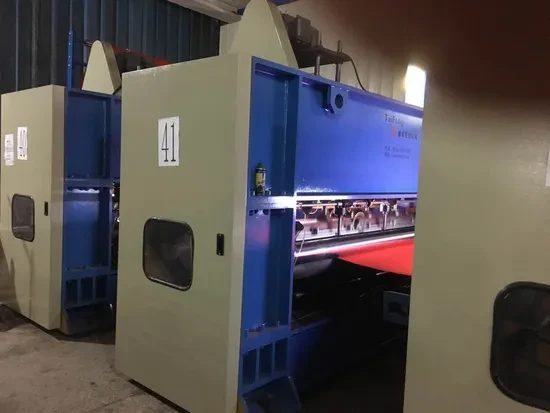
Our High Speed Needling Machine is a great example of a machine that benefits from these advanced controller features. It can operate at high speeds with precision, thanks to its intelligent controller that automates many of the processes and logs valuable production data.
In conclusion, the controller is an indispensable part of a non-woven machine. It plays a vital role in regulating speed, temperature, pressure, coordinating the movement of machine parts, and enabling automation and data logging. A high-quality controller can significantly improve the quality, efficiency, and productivity of non-woven fabric production.
If you're in the market for a non-woven machine and want to learn more about how our advanced controllers can benefit your production, feel free to reach out. We're always happy to have a chat and discuss your specific needs. Whether you're a small business looking to start producing non-woven fabrics or a large-scale manufacturer aiming to upgrade your equipment, we've got the right solutions for you. Let's work together to take your non-woven production to the next level.

References
- Industry knowledge and experience as a non-woven machine supplier.
- Technical documentation of non-woven machines and controllers.