

Hey there! As a supplier of Size Textile Non - Woven, I've been in the game for quite a while, and I often get asked about the commonly used sizes of textile non - woven in the stationery industry. So, I thought I'd sit down and write this blog to share what I know.
First off, let's talk about what non - woven materials are. Non - woven fabrics are made directly from fibers without the need for weaving or knitting. They're super versatile and have a wide range of applications, including in the stationery world. There are different types of non - woven manufacturing processes, like Spunbond Nonwoven Fabric Manufacturing. This process involves extruding molten polymer filaments and then bonding them together to form a fabric. It results in a strong and durable non - woven material.
Now, onto the sizes. In the stationery industry, the most commonly used sizes of textile non - woven can vary depending on the specific product. For example, for notebook covers, a common size is around A4 (210mm x 297mm) or A5 (148mm x 210mm). These sizes are standard for notebooks, and using non - woven materials for covers gives them a soft yet sturdy feel. Non - woven is also great for protecting the pages inside and adding a bit of style.
Another popular use in the stationery industry is for pencil cases. For small, single - compartment pencil cases, a size of around 180mm x 80mm is often used. This is just big enough to hold a few pencils, pens, and maybe a small eraser. Larger, multi - compartment pencil cases can be around 220mm x 120mm, providing more space for a variety of stationery items.
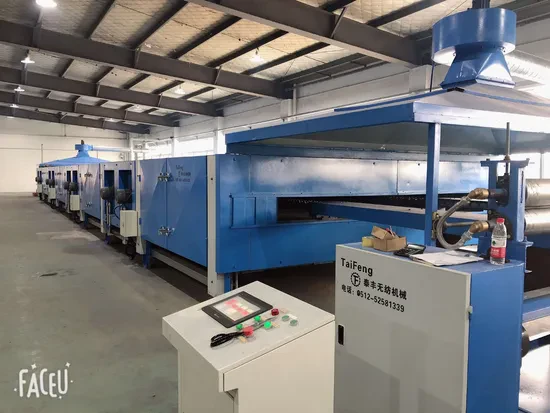
When it comes to making these stationery products, the Production Line Needle Punched Felt Machine can be quite handy. This machine uses needles to entangle the fibers in the non - woven material, giving it a denser and more stable structure. It's perfect for creating the kind of non - woven fabric that's needed for durable stationery items.
For some stationery products like desk mats or coasters, square or rectangular non - woven pieces are used. A common size for desk mats is around 300mm x 400mm. This provides enough space to rest your hands while writing or using a mouse. Coasters, on the other hand, are usually smaller, around 100mm x 100mm. Non - woven coasters are great because they can absorb a bit of moisture and protect your desk from water rings.
The Non Woven Carpet Making Machine might seem a bit out of place in the stationery industry at first glance, but it can actually be used to create some unique non - woven materials. Some high - end stationery products use non - woven materials with a carpet - like texture for a more luxurious look and feel.

One of the advantages of using non - woven materials in the stationery industry is their cost - effectiveness. They're generally cheaper to produce compared to traditional woven fabrics, and they can be easily customized in terms of color, texture, and size. You can also print on non - woven materials, which is great for adding logos, designs, or patterns to your stationery products.
In addition to the standard sizes I've mentioned, there's also a growing trend of using custom - sized non - woven materials in the stationery industry. Designers are coming up with more innovative and unique stationery products, and they need non - woven materials that fit their specific visions. As a supplier, I'm always ready to work with customers to produce non - woven materials in the exact sizes they need.
The thickness of the non - woven material also matters in the stationery industry. For notebook covers, a medium - thickness non - woven (around 0.3mm - 0.5mm) is usually sufficient. It provides enough rigidity to keep the notebook in shape without being too bulky. For pencil cases, a slightly thinner non - woven (around 0.2mm - 0.3mm) can be used, as it allows for more flexibility and easier folding.
When it comes to sourcing non - woven materials for the stationery industry, it's important to choose a reliable supplier. You want someone who can provide high - quality materials in the right sizes and at a reasonable price. That's where I come in! I've been in the business for years, and I know how to meet the specific needs of the stationery industry.
If you're in the stationery business and looking for the right non - woven materials, I'd love to have a chat with you. Whether you need standard sizes or custom - made non - woven, I can help you find the perfect solution for your products. Just reach out, and we can start discussing your requirements.
In conclusion, the stationery industry uses a variety of sizes of textile non - woven materials, from A4 and A5 for notebook covers to smaller sizes for pencil cases and coasters. With the right manufacturing processes and a reliable supplier, you can create high - quality stationery products that stand out in the market. So, don't hesitate to get in touch if you're interested in working together.
References:
- Industry knowledge and experience as a Size Textile Non - Woven supplier.
- General research on non - woven materials and their applications in the stationery industry.